Layers of Stone, Layers of Time
Ulcinj's Old Town sits on a rocky promontory that drops straight into the Adriatic on three sides. The site has been continuously fortified for at least 2,500 years. Illyrians built the first walls. Romans expanded them. Venetians added bastions and a sea gate. Ottomans held the town for over three centuries and left behind mosques, hammams, and the narrow stone lanes that still define the layout today.
What makes the Old Town unusual is the density of this layering. You can stand on a Venetian bastion and look down at Roman foundations, then turn around and see an Ottoman minaret rising above a roofline that has barely changed since the 17th century. Nowhere else on the Montenegrin coast packs this much history into so small a space.
Getting In
There are two gates. The main entrance is on the landward side, reached by a short uphill walk from the town centre. The second is a smaller sea gate on the western wall that opens onto a staircase dropping to the rocks below. Drive to the car park at the base of the walls, it is free outside of July and August, and walk up through the main gate. The climb takes two minutes.
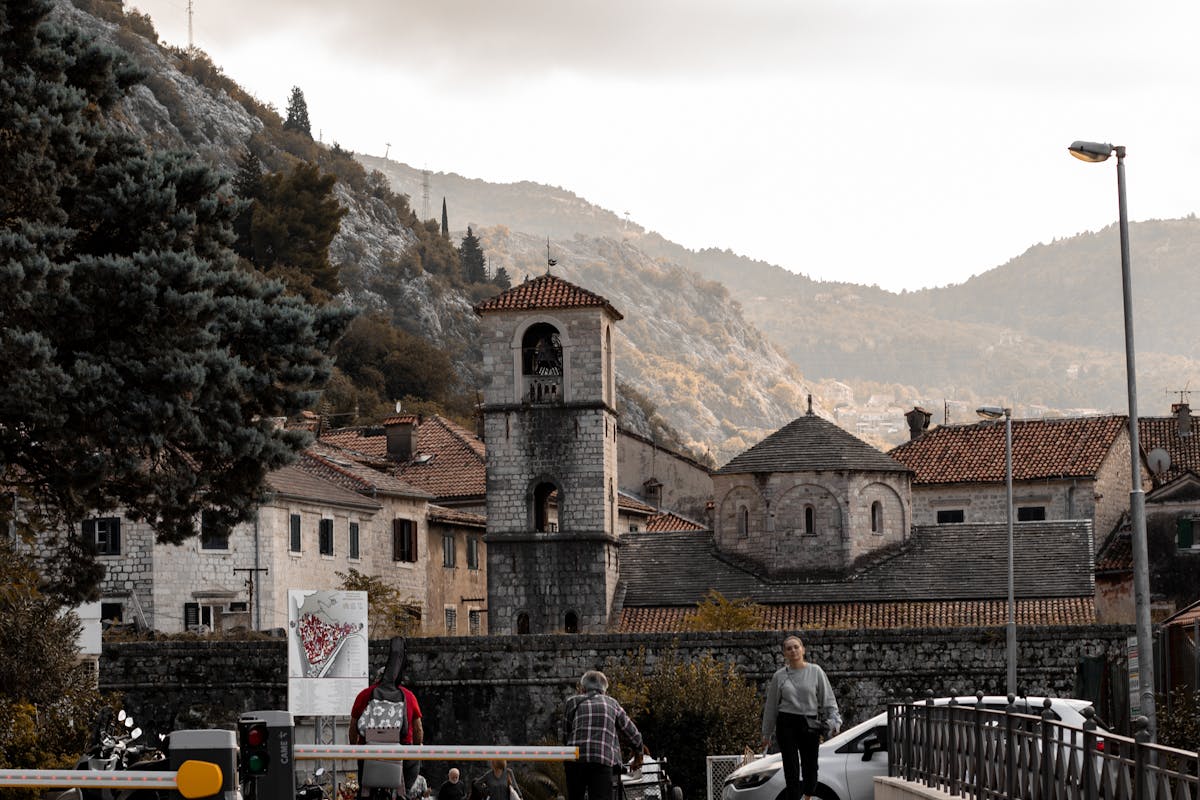
The Mosques Inside the Walls
The Sailors' Mosque (Dzamija Namazgjah) sits just inside the main gate. It was built in 1719 and served the Ottoman garrison. The minaret is one of the tallest structures inside the walls and provides a useful orientation point as you explore. The mosque is generally open to visitors outside of prayer times, remove your shoes at the entrance.
A second, smaller mosque stands near the southern bastion. From its terrace you can see across the strait to the coast of Albania on clear days. If you are visiting during the quieter months, combine the Old Town with a drive to Valdanos Bay on the same afternoon, the road north takes about 15 minutes.
Walking the Walls
The fortification circuit is not a formal walkway like the ones in Dubrovnik or Kotor. Instead, you pick your way along sections of the ramparts where the stone is stable enough to walk on. The best stretch runs along the western wall above the sea, where the drop is sheer and the view extends to the islands off the Albanian coast. In late afternoon the light turns the stone golden and the Adriatic deepens to indigo.
After exploring the walls, walk down through the sea gate to the rocks below for a swim. The water here is deep, clear, and sheltered from the afternoon wind. Then head back into the lanes for dinner, our guide to Ulcinj's seafood restaurants.
The Ethnographic Museum
A small museum inside the walls houses Ottoman-era artefacts, old photographs of the town, and a collection of traditional dress from the Ulcinj region. The displays are modest but well curated. Allow 20 minutes. The museum is closed on Mondays.
Practical Tips
- Best time: Late afternoon for the best light and cooler temperatures. The western walls face the sunset.
- Footwear: The cobblestones are polished smooth. Trainers or sandals with grip, not flip-flops.
- Parking: Free car park at the base of the walls. Paid in July, August (€2/hour).
- Sunset: The western bastion is the best sunset viewpoint in Ulcinj. Arrive 30 minutes early in summer.